Is Your Workshop Environment Silently Undermining Your High-Precision 3D Prints?
A high-precision 3D printer can follow a carefully prepared toolpath and still produce an inaccurate part. Dimensional drift, inconsistent layer bonding, unexpected warping, and surface defects are not always signs of poor machine calibration or unsuitable slicer settings. Sometimes, the underlying problem is the space surrounding the printer. The high-precision 3D printing environment plays a direct role in determining whether a machine can reproduce the intended geometry and material properties consistently.
Temperature fluctuations, humidity, airborne particles, and inadequate ventilation can introduce variables that are difficult to identify from the finished part alone. These conditions matter particularly in engineering laboratories, prototyping facilities, and production workshops where repeatability is more important than simply completing a successful print.
- Temperature: Stabilize the printer surroundings and prevent drafts or sudden thermal changes.
- Humidity: Protect moisture-sensitive filament and monitor storage conditions.
- Air quality: Manage particles, fumes, and workshop contaminants appropriately.
- Enclosure: Reduce uncontrolled airflow and temperature variation when the printing process benefits from a controlled chamber.
- Monitoring: Record environmental conditions alongside print settings to identify recurring problems.
1. Why the Surrounding Environment Matters More Than Expected
Precision printing is a process of controlling numerous interacting variables. Nozzle temperature, extrusion rate, layer height, cooling behavior, motion accuracy, and material characteristics all influence the finished component. Environmental conditions add another layer of complexity because they can change while a print is running.
Consider a machine operating in a workshop near an exterior door. During the morning, the surrounding air may be relatively stable. Later, the door opens repeatedly, introducing cooler or warmer air. Even if the printer continues operating normally, the changing conditions can affect cooling rates, material contraction, and the stability of the printing process.
The consequences depend on the technology, material, machine design, and geometry being produced. A small decorative PLA component may tolerate conditions that would create problems for a large engineering part made from ABS, ASA, or another temperature-sensitive material.
This distinction is important: environmental control is not about making every workshop resemble a cleanroom. It is about controlling the variables that materially influence the intended application.
2. Temperature Stability and Dimensional Accuracy
Temperature is among the most influential environmental variables in additive manufacturing. Thermoplastics expand when heated and contract when cooled. If different regions of a printed component experience substantially different cooling conditions, internal stresses can develop.
These stresses may contribute to corner lifting, layer separation, distortion, or dimensional changes. The risk becomes particularly noticeable when producing large parts, components with broad flat surfaces, and geometries containing thin walls or uneven material distribution.
Ambient temperature versus chamber temperature
Two temperatures should not be confused:
- Ambient temperature: The temperature of the air surrounding the printer and its immediate workspace.
- Chamber temperature: The temperature inside an enclosure or controlled printing chamber.
A workshop can feel comfortable to an operator while still providing an inconsistent thermal environment for a printer. Likewise, an enclosure can reduce drafts without necessarily maintaining a precisely controlled chamber temperature.
For materials such as PLA, excessive chamber heat can create its own problems. Heat-sensitive components, electronics, and filament feeding mechanisms may not perform well in an unnecessarily hot enclosure. For ABS and other materials that benefit from elevated chamber temperatures, a more controlled thermal environment can help reduce warping and improve interlayer consistency.
If you regularly print large ABS, ASA, or similar engineering components and encounter warping or layer separation, evaluate an appropriate enclosure. If your primary workload consists of smaller PLA components, begin with draft reduction and temperature monitoring before investing in active chamber heating.
How to identify temperature-related problems
Look for repeatable patterns rather than isolated defects. If corner lifting becomes more frequent during colder periods, or if the same component behaves differently depending on workshop airflow, the environment deserves investigation.
Useful observations include:
- Differences between morning and afternoon print results.
- Warping concentrated near exposed edges or corners.
- Layer adhesion problems following sudden temperature changes.
- Different results when the printer operates near ventilation outlets or doors.
- Dimensional inconsistencies between otherwise identical production runs.
These observations do not prove that temperature is responsible. Mechanical looseness, incorrect bed preparation, unsuitable cooling, and material incompatibility can produce similar symptoms. Environmental investigation should therefore complement ordinary machine diagnostics.
3. Humidity: The Hidden Variable in Filament Performance
Humidity is particularly important because many common 3D printing polymers absorb moisture from their surroundings. The degree of moisture absorption varies considerably between materials.
Polyamide, commonly known as nylon, is especially moisture-sensitive. PETG and TPU can also experience moisture-related processing problems. PLA generally absorbs less moisture than nylon, but it is not immune to degradation during unsuitable storage.
When moisture enters filament, heating during extrusion can produce undesirable effects. Depending on the polymer and moisture level, symptoms may include popping sounds, bubbles, inconsistent extrusion, rough surfaces, stringing, and reduced mechanical performance.
Why the same filament can produce different results
A spool that printed successfully when newly opened may behave differently after remaining exposed to humid workshop air. The printer's mechanical configuration might be unchanged, but the condition of the material has changed.
This is one reason why experienced operators distinguish between printer problems and material-handling problems. Increasing nozzle temperature or changing retraction settings may temporarily alter the visible symptoms without addressing the actual moisture issue.
A more reliable workflow combines suitable filament storage, manufacturer-recommended drying procedures, and environmental monitoring.
Storage is often more important than room dehumidification
Controlling humidity across an entire workshop can be expensive and unnecessary for some operations. A localized filament storage system may deliver more practical benefits.
Sealed containers, suitable desiccants, and dedicated filament dryers can protect vulnerable materials. For demanding applications, operators should also consider how long filament remains exposed during printing.
Room-level humidity readings are useful, but they do not directly reveal the moisture content of a particular spool. A hygrometer measures the surrounding air, not the internal condition of the polymer.
4. Air Quality, Dust, and Workshop Contamination
Air quality is often treated as a worker-comfort issue rather than a manufacturing-quality issue. In reality, airborne contamination can affect both the printing process and the surrounding equipment.
Dust can accumulate on motion components, cooling fans, exposed surfaces, and mechanical assemblies. Depending on the machine design and maintenance schedule, contamination may contribute to increased wear, restricted airflow, or inconsistent cooling.
Workshops that combine 3D printing with sanding, CNC machining, woodworking, laser processing, or grinding require particular attention. These activities can generate particles and fumes that should not be allowed to circulate freely around sensitive manufacturing equipment.
Three different air-quality concerns
1. Airborne particulate matter. Fine dust can settle on equipment and work surfaces. Certain particles may also enter printer mechanisms or interfere with clean manufacturing procedures.
2. Printing-related emissions. Some thermoplastic printing processes release ultrafine particles and volatile organic compounds. Emissions vary with polymer type, additives, processing temperature, printer design, and operating conditions.
3. Cross-contamination. Dust and residues from unrelated workshop operations can migrate into the printing area. This matters especially when producing parts that require controlled surface cleanliness or subsequent bonding and coating.
Where air purification fits into the process
Workshop air purification systems can help manage airborne contaminants when correctly selected and positioned. However, an ordinary room air cleaner is not automatically a substitute for source capture or properly designed exhaust ventilation.
Particle filtration and gas-phase filtration address different problems. A HEPA filter is designed to capture particles within its specified performance range. Activated carbon media can adsorb certain gaseous contaminants, but its effectiveness depends on the contaminant, media quantity, airflow, contact time, and maintenance condition.
For this reason, an air purifier should be considered part of a broader ventilation strategy rather than a universal solution.
Containing emissions does not eliminate them. A poorly designed enclosure can allow contaminants to accumulate, and opening its door may release concentrated air into the room. Do not assume that an internal filter makes every material safe to print in an occupied workshop.
Follow the printer and material manufacturer's safety guidance. Where appropriate, use properly engineered exhaust ventilation, suitable filtration, and an established workplace exposure-control program.
5. Comparing the Main Environmental Control Variables
Environmental improvements should be prioritized according to the failure modes affecting the actual production process. The following comparison provides a practical way to distinguish the purpose of each intervention.
The important distinction is that these interventions are not interchangeable. A dehumidifier cannot remove printing emissions, a HEPA purifier cannot stabilize chamber temperature, and an enclosure cannot guarantee dry filament.
Effective environmental management therefore begins by identifying the dominant problem rather than purchasing equipment based on a general assumption that more environmental control must always be better.
6. Building a More Controlled High-Precision 3D Printing Environment
A controlled workshop does not necessarily require expensive industrial infrastructure. For many facilities, a combination of sensible equipment placement, monitoring, material storage, and targeted environmental improvements can provide a meaningful improvement in process consistency.
Start with printer placement
Position the printer away from frequently opened doors, direct sunlight, strong heating outlets, and uncontrolled ventilation streams. Avoid placing precision equipment directly beside machinery that generates substantial dust or vibration.
Where multiple manufacturing processes share one room, separate the printing area from dusty operations whenever practical. Physical separation can be more effective than repeatedly cleaning equipment after contamination occurs.
Use an enclosure for the right reasons
3D printer enclosures can provide a more stable thermal environment, reduce drafts, and help contain some airborne emissions and particles. Their usefulness depends on the printer architecture and material being processed.
A passive enclosure may be sufficient for applications where the main objective is reducing temperature fluctuations. More demanding processes may require a manufacturer-designed chamber with controlled heating and monitoring.
However, an enclosure introduces trade-offs. Heat accumulation can affect electronics, motors, and components not designed for elevated temperatures. Maintenance access may become less convenient, and enclosed spaces require appropriate consideration of ventilation and electrical safety.
Separate environmental monitoring from machine monitoring
Modern printers may already report nozzle temperature, bed temperature, and other machine parameters. Those measurements do not necessarily describe the conditions surrounding the machine.
Adding independent temperature and relative-humidity sensors can help establish whether workshop conditions are changing during production. More advanced facilities can also monitor relevant air-quality indicators based on their processes and exposure-control requirements.
The objective is not to collect every possible measurement. It is to identify which environmental changes correlate with actual production defects.
7. What to Do Now: A Practical Workshop Improvement Plan
When production quality is inconsistent, changing multiple environmental variables simultaneously can make troubleshooting difficult. A staged approach makes it easier to determine which intervention actually improves repeatability.
Priority 1: Establish a baseline
Record the workshop temperature, relative humidity, material type, storage conditions, printer location, and relevant machine settings. Use consistent measurement locations and record readings at comparable times.
Keep a short production log containing the following information:
- Material and filament manufacturer.
- Spool storage and drying history.
- Printer and enclosure configuration.
- Ambient temperature and humidity.
- Visible defects and dimensional inspection results.
- Changes in airflow, ventilation, or workshop activity.
Priority 2: Address the most likely cause
If warping increases when the workshop becomes colder, investigate drafts and thermal stability before changing unrelated extrusion settings.
If extrusion becomes inconsistent after filament has been left exposed, investigate moisture before replacing the nozzle or modifying the motion system.
If dust accumulation is the recurring concern, improve housekeeping and source extraction rather than assuming that an enclosure alone will resolve contamination.
Priority 3: Introduce one improvement at a time
For example, install a temperature and humidity monitor first. Observe the conditions during several comparable production cycles. If a consistent relationship appears, introduce the relevant control measure and repeat the process.
This method prevents unnecessary spending and creates a more defensible understanding of workshop performance.
Workshop environmental checklist
- ☐ Check that the printer is away from uncontrolled drafts.
- ☐ Record ambient temperature and relative humidity.
- ☐ Confirm that the selected filament has been stored appropriately.
- ☐ Dry moisture-sensitive material according to manufacturer guidance when necessary.
- ☐ Inspect the enclosure, seals, and ventilation arrangements.
- ☐ Check that cooling fans and air pathways are unobstructed.
- ☐ Remove accumulated dust from the surrounding workspace.
- ☐ Confirm that source extraction or air filtration is operating as intended.
- ☐ Review unusual environmental changes during long print jobs.
- ☐ Document dimensional and surface-quality results.
8. When Environmental Control Is Worth the Investment
Not every workshop needs the same level of environmental infrastructure. The appropriate investment depends on the material portfolio, required tolerances, production volume, and consequences of a failed component.
For occasional PLA prototyping, basic monitoring and sensible filament storage may be sufficient. A costly climate-control system may provide little measurable benefit if the existing workshop conditions are already stable and the parts have relatively forgiving dimensional requirements.
For engineering applications involving nylon, ABS, ASA, or other demanding materials, the situation can be different. Material drying, chamber stability, and controlled airflow may become important process requirements.
Facilities producing repeatable components across multiple machines may benefit from a more comprehensive approach. Environmental monitoring can help distinguish equipment-specific defects from problems shared by the entire workshop.
Think in terms of production risk
A useful decision framework is to compare the cost of environmental intervention with the cost of recurring production failures.
- If defects are occasional and difficult to reproduce: Begin with monitoring and process documentation.
- If warping repeatedly occurs with temperature-sensitive materials: Evaluate enclosure performance and workshop thermal stability.
- If filament quality deteriorates during storage: Prioritize sealed storage and appropriate drying equipment.
- If printing emissions or workshop dust are the primary concern: Evaluate source capture, ventilation, and suitable air purification.
- If several machines show similar defects: Investigate shared environmental conditions before replacing individual printers.
This approach also reveals an important limitation: environmental control cannot correct every manufacturing defect. A bent frame, worn bearing, inaccurate motion system, poor filament formulation, or incorrect slicer configuration requires a different solution.
9. Common Environmental Management Mistakes
Even workshops with substantial equipment investments can struggle when environmental controls are poorly integrated into the manufacturing process.
Assuming a sealed enclosure solves everything
Enclosures can improve thermal stability, but they do not automatically control humidity, remove all emissions, or guarantee uniform chamber temperatures. Their design and operating conditions matter.
Confusing relative humidity with filament moisture content
Relative humidity describes the air at a particular temperature. It is not a direct measurement of how much water a filament spool has absorbed. Material storage history and polymer characteristics remain important.
Installing filtration without considering airflow
Filter performance depends on more than the filter label. Airflow rate, placement, sealing, maintenance, and the type of contaminant determine whether the system is appropriate for the intended application.
Changing too many variables at once
Simultaneously modifying nozzle temperature, cooling, chamber conditions, and filament drying can make the results difficult to interpret. Controlled changes are more useful because they preserve the ability to identify cause and effect.
Ignoring maintenance
Environmental equipment is not maintenance-free. Filters become loaded, desiccants lose effectiveness, seals deteriorate, and sensors may drift. A control system that is not maintained can create false confidence in workshop conditions.
10. Frequently Asked Questions
1. Does room temperature directly affect 3D printing accuracy?
Yes, it can. Ambient temperature influences cooling conditions and the thermal behavior of printed materials. Large fluctuations and uncontrolled drafts can contribute to warping, dimensional variation, and inconsistent layer bonding. However, the magnitude of the effect depends on the printer, polymer, geometry, and chamber design.
2. What humidity level is suitable for a 3D printing workshop?
There is no single ideal relative-humidity value for every printer and material. The manufacturer's recommendations should guide material handling and storage. Moisture-sensitive polymers require particular attention, and sealed storage with suitable desiccants can be useful even when the workshop itself has reasonably controlled humidity.
3. Does every high-precision 3D printer need an enclosure?
No. Some machines and materials operate effectively without an enclosure. Others benefit substantially from reduced drafts and more stable chamber temperatures. The decision should be based on material requirements, part geometry, manufacturer guidance, and observed defects rather than the assumption that an enclosure always improves accuracy.
4. Can an air purifier remove all 3D printing emissions?
No. Different emissions require different control methods. Particle filtration and activated carbon filtration serve different purposes, and their effectiveness depends on system design. Properly designed source extraction and ventilation may be necessary, particularly when printing materials associated with greater emissions.
5. Why does filament become difficult to print after storage?
Some polymers absorb moisture from surrounding air. Moisture can contribute to bubbling, popping, inconsistent extrusion, and surface defects during printing. Appropriate sealed storage and manufacturer-recommended drying procedures can help restore suitable processing conditions when the material has absorbed moisture and remains otherwise usable.
6. Is a workshop dehumidifier better than a filament dryer?
They serve different purposes. A dehumidifier reduces moisture in the surrounding air, while a filament dryer is designed to remove moisture from the material itself. If a spool has already absorbed moisture, reducing room humidity alone may not dry it adequately. Both solutions can be useful in different circumstances.
7. How can I determine whether a printing defect is environmental?
Look for patterns across multiple prints and compare results with temperature, humidity, material condition, and airflow observations. If several machines experience similar problems under the same workshop conditions, a shared environmental factor becomes more plausible. Nevertheless, mechanical and material-related causes should also be investigated.
8. Are environmental monitoring systems necessary for small workshops?
Not always. A basic thermometer and hygrometer may provide enough information for a small prototyping workspace. More advanced monitoring becomes valuable when production is sensitive to environmental variation, multiple machines operate simultaneously, or quality documentation is required.
Conclusion: Precision Begins Before the First Layer
High-precision additive manufacturing is often approached as a machine-centered discipline. Operators invest time in calibration, nozzle selection, slicer optimization, motion accuracy, and material settings. These remain essential, but they do not operate independently of the workshop surrounding the printer.
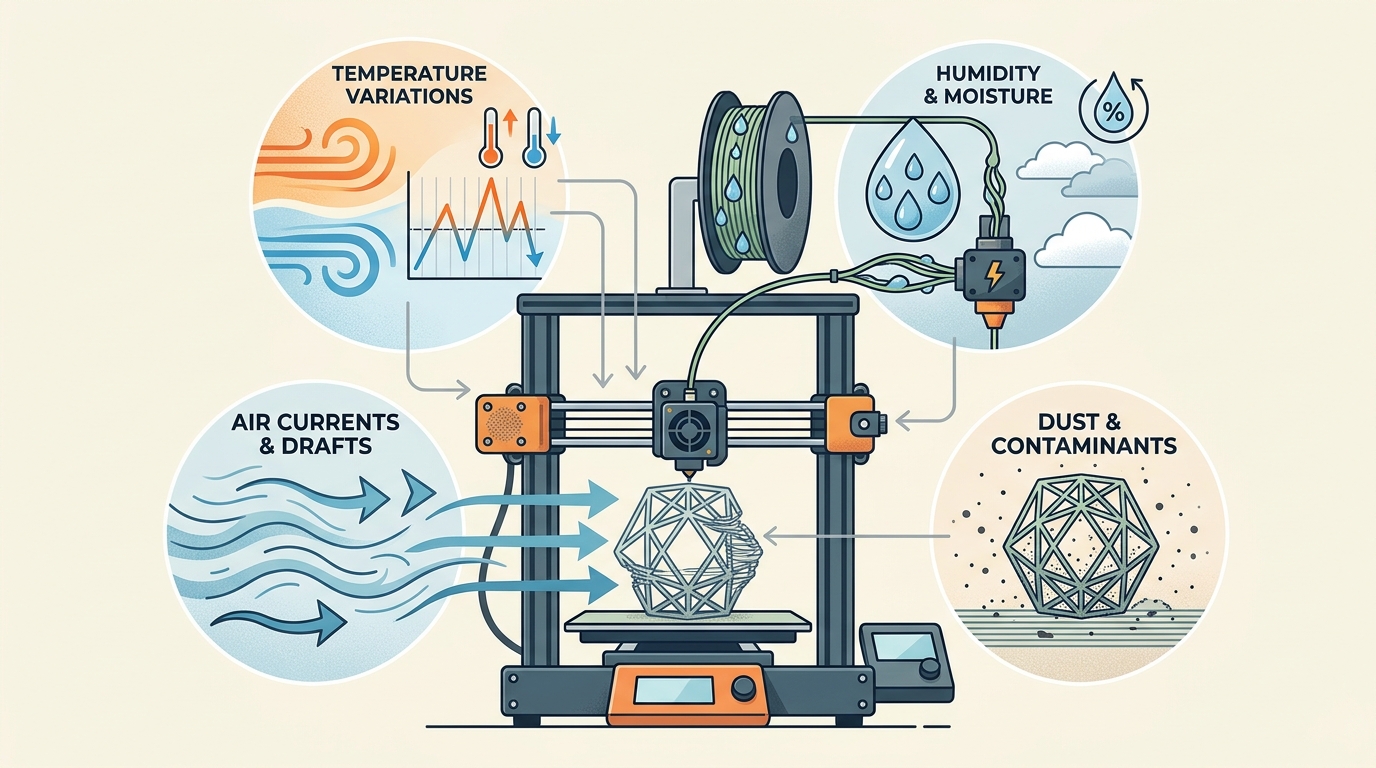
Temperature stability influences how printed polymers cool and contract. Humidity affects the condition and processing behavior of moisture-sensitive filament. Airborne dust and printing emissions introduce equipment-maintenance and workplace-safety concerns. Enclosures, environmental monitoring, suitable filament storage, and properly designed ventilation address different parts of this broader challenge.
The most effective strategy is not to purchase every available environmental control system. It is to identify the conditions most likely to undermine the intended manufacturing result, establish a measurable baseline, and introduce targeted improvements.
For a workshop experiencing temperature-related warping, chamber stability may deserve priority. For inconsistent extrusion after storage, filament moisture management is a more logical starting point. For a facility combining additive manufacturing with dusty processes, separation, source extraction, and appropriate air purification may provide greater value.
Ultimately, the reliability of a precision-printed component depends on more than the accuracy of the printer's movements. It depends on the consistency of the complete process, including the material, machine, operator, and surrounding environment. Treating workshop conditions as measurable manufacturing variables can turn environmental management from an overlooked maintenance task into a meaningful part of quality control.


Comments
Post a Comment